
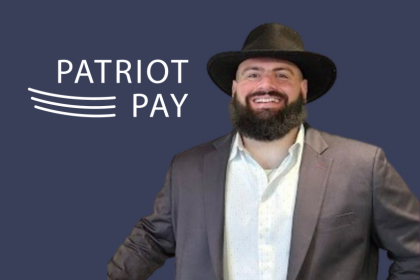
(As published by the Concord Monitor)
Growing up in Franklin with eight siblings made life exciting for Matthew Kaplan. But for his parents, who both worked in the health care industry, keeping track of all their childrens’ medical bills was a large pain point.
Kaplan recalled how many bills his family got in the mail and how confusing it was trying to remember which ones they settled and which ones still needed to be paid.
“The current system was completely broken, and I’m looking at all these advances we’re having in technology, nobody’s addressing 33% of the health care market which is the patient responsibility,” he said. “So, I set on a journey to make it easier for patients to pay their bill.”
In 2024, Kaplan founded Patriot Pay, a Manchester-based software company that allows patients to better understand and pay their medical bills. Since then, he has partnered with over 75 medical practices in the U.S., nearly 30 of which are in New Hampshire.
Traditionally, hospitals send paper statements that can be settled through the mail or through an online portal — in either instance, the amount owed is rarely broken down and itemized without being requested from a provider.
In contrast, Patriot Pay seeks to provide transparency, a feature Abigail Turner really likes.
“You actually knew what you were paying, how much your insurance paid and everything, so you understood it, which I thought was really great,” said Turner, a registered dietician from Concord who used the service through Granite State Gastroenterology.
Turner said she also liked the user-friendly interface and the security the platform provides.
In addition to these features, Kaplan said Patriot Pay has deployed innovative strategies to help patients pay on time. The service recently launched predictive pay, which sends reminders to patients based on their habits. A person who frequently visits their primary care doctor, for instance, is more likely to pay their balance quicker than someone who only visited urgent care once.
It also tracks what time of day a patient typically pays their bill and how many reminders they received before paying their bill, information it uses to train the model on when to nudge a user.
“Our software predicts exactly how long we need to work on patient balance for before the patient pays their bill,” Kaplan said. “We rolled that out and the results surpassed my expectations.”
He said many health care providers saw patient collections increase by three to ten times compared to using paper statements.
Brian Marquis, an administrator with Granite State Gastroenterology, said the software’s capabilities lowered the clinic’s days in accounts receivable, or how much money it is owed. Before Patriot Pay, the account was $181,000 with half of it being older than 120 days. Today, it is $89,000 with about 20% being over 120 days.
“It was clear that the way we were reaching out to patients prior to this, that those methods were less effective than what we got with Patriot Pay,” he said. “We had a surge of incoming payments for old accounts, which was really nice.”
Kaplan said he hopes the business will keep expanding its physical presence across the U.S. and improve its services as it receives feedback from health care centers and patients.
“I’m extremely proud of the fact that I was born and raised here in Franklin, New Hampshire,” Kaplan said. “I’m convinced we have a tiger by the tail. With all my heart, I believe this will be a multi $100 million business in very short order… This is a homegrown product, and it’s going to stay that way.”